AR Aging Reports
Track overdue customer invoices by age bucket to prioritise collections
AR Aging Reports
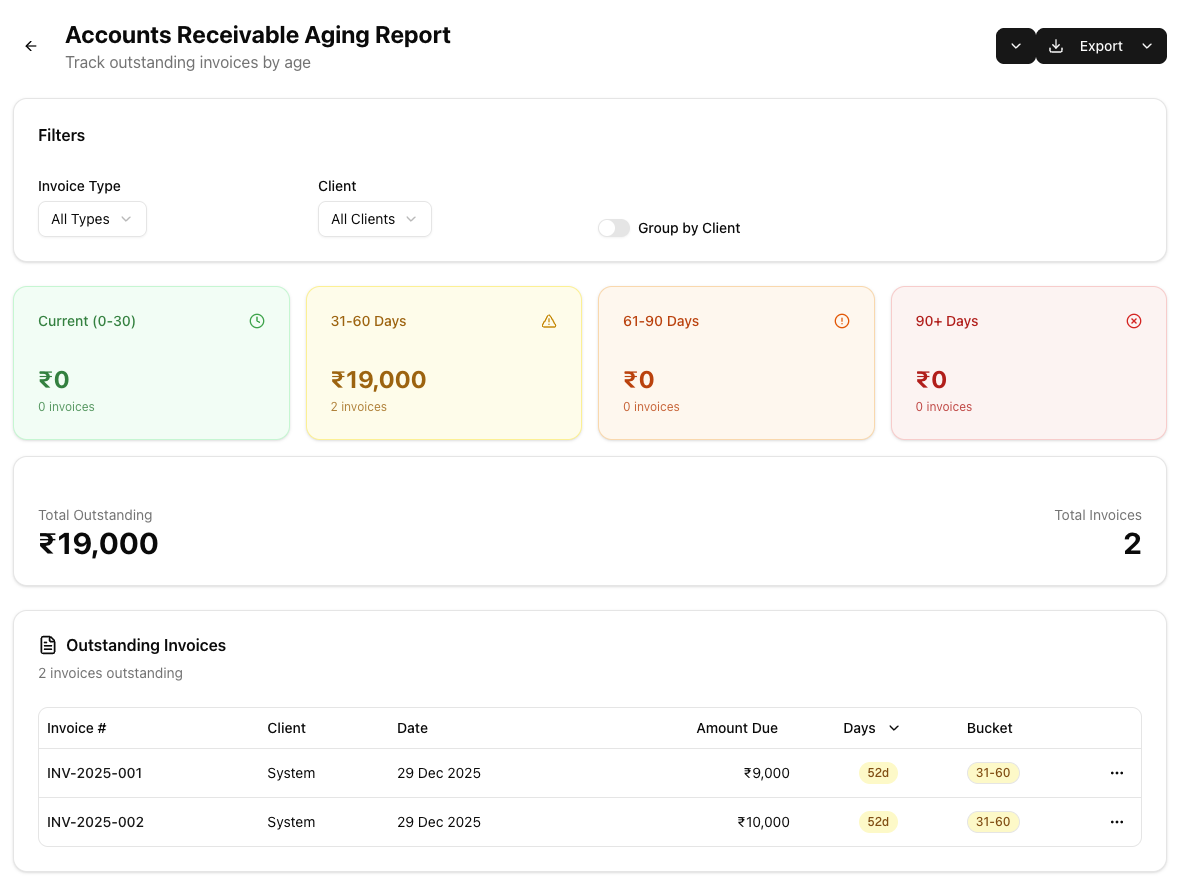
The Accounts Receivable Aging report breaks down your unpaid invoices into time-based buckets so you can see at a glance how long payments have been outstanding. Use it to prioritise collection efforts, identify clients with overdue balances, and monitor the overall health of your receivables.
How to Generate the Report
- Navigate to Reports from the sidebar.
- Under Financial Reports, click AR Aging.
- The report generates automatically using today as the "as of" date — there is no separate generate button.
Understanding the Report
Summary Cards
Four color-coded cards appear at the top of the page, one for each aging bucket:
| Card | Bucket | Colour |
|---|---|---|
| Current | 0–30 days | Green |
| 31–60 days | 31–60 days | Yellow |
| 61–90 days | 61–90 days | Orange |
| 90+ days | Over 90 days | Red |
Each card displays the number of invoices and the total amount in INR for that bucket. Click any card to filter the table below to only the invoices in that bucket.
Aging Table
Below the summary cards, a detailed table lists every outstanding invoice. The table columns are:
- Invoice Number — Links directly to the invoice detail page.
- Client — The client or party name.
- Invoice Date — The date the invoice was issued.
- Amount Due (Foreign) — The outstanding amount in the invoice's original currency (shown only for export invoices).
- Amount Due (INR) — The outstanding amount in Indian Rupees.
- Days Outstanding — Number of days since the invoice date.
- Bucket — The aging bucket the invoice falls into (Current, 31–60, 61–90, or 90+).
All columns are sortable — click a column header to sort ascending, click again for descending.
Filtering and Grouping
Use the controls above the table to narrow down the report:
- Invoice Type — Filter by All, Export, Domestic Intra-State, or Domestic Inter-State.
- Client — Select a specific client from the dropdown to view only their outstanding invoices.
- Group by Client — Toggle this on to group rows by client, with subtotals shown for each client.
- Bucket filter — Click any summary card to show only invoices in that aging bucket. Click the card again (or select a different card) to change the filter.
Exporting the Report
If you have the reports.export permission, a CSV export button is available in the report header. Clicking it downloads a file named aging-report-YYYY-MM-DD.csv containing the currently displayed data.
If you do not see the export button, ask your team admin to grant you the reports.export permission.
Tips and Best Practices
- Review the report weekly. Regular reviews help you catch overdue invoices early before they become difficult to collect.
- Prioritise the red bucket. Invoices over 90 days old are the hardest to collect — follow up on these first.
- Use the Group by Client view. This makes it easy to spot clients who consistently pay late so you can adjust credit terms or escalate collection efforts.
- Filter by invoice type for GST reconciliation. Separating export and domestic invoices helps when reconciling receivables against GST filings.
- Export before month-end close. Download a CSV snapshot of your aging data at the end of each month for your records and audit trail.
Export receivables and FEMA deadlines
For export invoices, aging buckets map to FEMA realization deadlines. Use the Invoice Type > Export filter to isolate export receivables and assess FEMA risk:
| Aging bucket | FEMA significance |
|---|---|
| 0–9 months | Safe zone — well within the realization period |
| 9–12 months | Within extended period — monitor closely and follow up with clients |
| 12–15 months | Approaching the 15-month deadline — active follow-up needed |
| 15+ months | Overdue — FEMA contravention risk; contact your AD bank about extensions or write-off |
Cross-reference with the realization tracker on individual invoices and the export compliance report for eBRC and e-FIRC status.
Related Articles
- Balance Sheet — Review your overall financial position, including total receivables.
- Profit & Loss Statement — Understand revenue and expenses for the period.
- Trial Balance — Verify that all account balances are correct.
- Ledger Reports — Drill into individual account transactions.
- Date Ranges — Learn how date presets and financial year selectors work across reports.
- Realization tracking — Monitor payment realization deadlines under FEMA
- Export compliance report — View eBRC status and realization across all export invoices
- eBRC compliance — Record GSTIN and invoice details for Bank Realization Certificates